Sunrise and Sunset at the Cliffs of Moher: Getting the Light Right
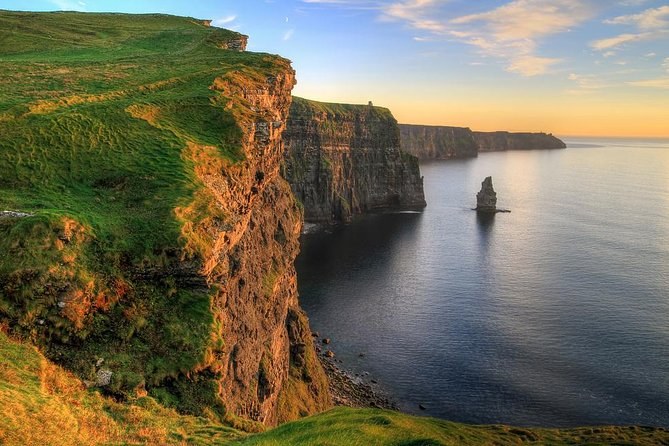
The short answer. These cliffs face due west, so sunset is the event and sunrise is not. In high summer the gate stays open until nine, the attraction charges least for arrivals after four, and it openly advises visitors to avoid eleven to four. Three separate facts, all pointing at the same hour.
Most attractions have a best time and hide it. This one publishes it three different ways, and almost nobody acts on it — which is why a late arrival is the cheapest upgrade available on a Cliffs of Moher booking.
Why west-facing decides everything
The wall runs roughly north to south along the Clare coast and looks out over open Atlantic. In the morning the sun is behind you and the face of the cliff is in its own shadow — flat, grey and hard to photograph. Through the middle of the day it is overhead, which is the least interesting light any landscape gets.
In the last two hours before sunset the sun comes round onto the face. The shale and sandstone bands catch it, the rock goes from grey to amber, and the sea stack throws a shadow. That is the photograph everybody has seen, and it is taken in the evening.
What the attraction's own pricing tells you
| Arrival band | When | What it says |
|---|---|---|
| Off-Peak AM | 8am to 11am | Cheapest, quietest, and the sun behind the wall |
| Peak | 11am to 4pm | Dearest, busiest, flattest light |
| Off-Peak PM | 4pm to closing | Cheapest again, thinning crowds, the good light |
The attraction advertises up to 45% off the peak rate for the two off-peak bands and separately recommends avoiding eleven to four. Read those together and the conclusion writes itself: the worst hours cost the most, and the best hours cost the least.
The individual online prices sit inside the booking system and are not published outside it, so no figure for them appears here. The structure is the useful part. The visitor information page has the gate rates in full.
The summer closing time nobody plans around
The published hours are 8am to 7pm, and they move with the season — nearer 9am to 5pm in the depth of winter and as late as 9pm at the height of summer. In June and July the sun on this coast does not set until well after nine, which means that for a few weeks the site is open through most of the golden hour.
Almost no coach tour uses it. The day tours are built around returning to Galway or Dublin in the evening, so they arrive in the middle of the day and leave before the light turns. If the photograph matters to you, that is an argument for a car, a private day or a late departure rather than for a bigger coach.
Sunrise, honestly
Sunrise here is not the event sunset is, and it is worth saying plainly rather than pretending otherwise. The sun comes up behind the cliffs, so what you get is the sky lightening over the Burren and the wall staying dark for another hour.
What sunrise does give you is the site to yourself, and on a clear morning the view out to the Aran Islands is at its sharpest before the haze builds. If you are staying in Doolin or Liscannor and you are an early riser, it is a genuinely different visit. It is just not a light show.
Which tours land you there at the right hour
- The midday departure from Galway. Leaves at noon and reaches the cliffs in the afternoon, which is the only coach day here built around the later light. Two hours on top.
- A private car. The whole point of one is that the schedule is yours. Ask for a late arrival when you book.
- The guided walk from Galway. Four hours on the cliff path stretching into the afternoon, which means you are there as the light changes rather than passing through.
- Staying in Doolin. Six kilometres away, and the walk in from the village is a genuine option in long summer daylight.
The Dublin coaches cannot help with this, and it is not a fault: thirteen hours is already the length of the day, and an evening arrival would make it sixteen. The Dublin page sets out what those days can and cannot do.
What the light does month by month
May and June are the sunniest months on this coast, at around five and a half to six hours of sunshine a day, and they also have the longest evenings. April is the driest. December has under two hours of sun a day and closes at five, which makes a winter visit an exercise in taking whatever hour you are given.
Autumn is the underrated one. September still has four hours of sun a day and fourteen degrees, and the crowds fall away from the first week. The weather page has all twelve months.
When the light will not happen at all
Sea fog does not care what time you booked. It arrives fast, sits on the headland and takes the view entirely. If it beats you, the attraction lets a ticket be reused within twenty-four hours, and staff will tell you the visibility as you arrive — so a spoiled afternoon can become a second attempt the next morning. On a guided day, free cancellation up to twenty-four hours ahead is the equivalent. The FAQs cover how each operator handles it.
Where to stand when the light turns
Two viewpoints, and they do different jobs. North, at O'Brien's Tower, you are on the high ground looking back down the wall, which is the classic composition and the one with the tower in it if you walk a little past. South, at the platform, you are lower and looking north along the face, with the sea stack in the middle distance — and it is considerably quieter at any hour.
The south platform is also where the puffin colony on Goat Island is visible between late May and mid-July, which is the one time of year when the evening gives you birds as well as light. The facts page has the rest of the seabird calendar.
Getting away again afterwards
This is the part an evening visit has to solve. There is no railway station and no year-round bus, and the free Burren & Cliffs Explorer shuttle only runs from 21 May to 20 September. Outside those months an evening at the cliffs means a car or a private driver, and inside them it still means checking the last service.
Doolin, six kilometres north, is the practical base for anyone who wants the light without the drive — it is the nearest village with somewhere to eat afterwards, and it is where the coastal path starts. How to get there sets out every approach.
The practical version
- Book an arrival after four if you are driving, and before eleven if you want it empty.
- In June and July, plan to still be there at eight.
- Bring a windproof layer for standing still — sunset watching is colder than walking.
- Do not plan a sunrise trip for the light; plan it for the solitude.
- Accept that on this coast the sky is the variable, and book something you can cancel.
One coach day here is built around the afternoon light. See the Cliffs of Moher tours from Galway.
Days that reach the cliffs later
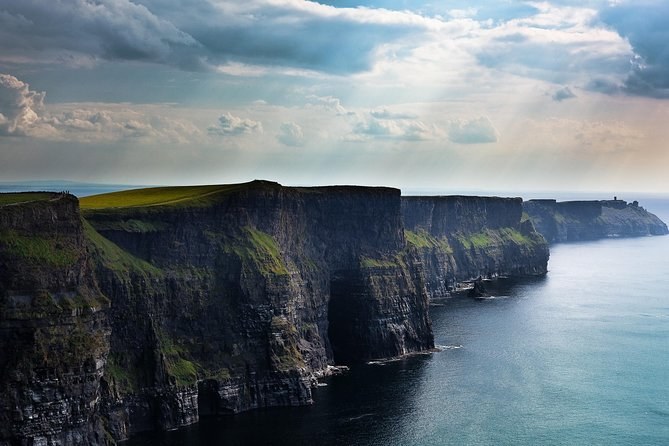
12:00 Cliffs of Moher Tour
A noon departure that reaches the cliffs after the morning coaches have gone, with two hours up there and the entry fee in the fare.
From $64 per person
Check Availability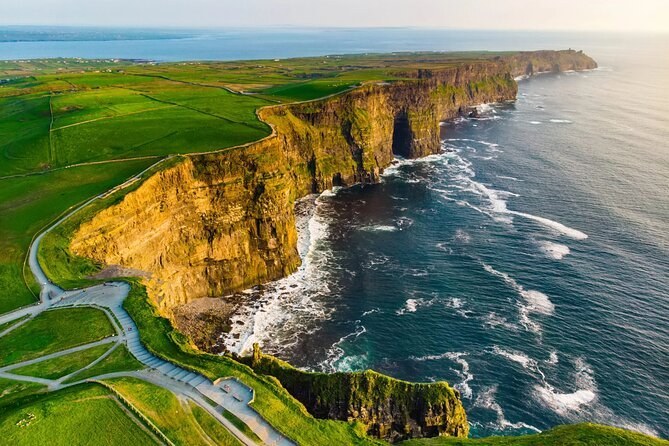
Private Cliffs of Moher Tour Small Group from Galway, Ireland
Five or six hours on a route no coach runs — the Flaggy Shore, the Burren Perfumery and ninety minutes at the cliffs.
From $725 per group, up to 4
Check Availability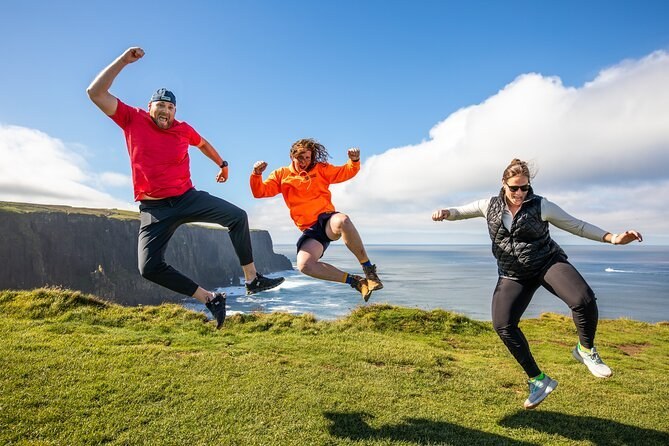
Cliffs of Moher Hiking Tour from Galway - Small Group
Four hours walking the cliff path in a group of eight, with the visitor centre entry paid and two hours in Doolin at the end.
From $104 per person
Check AvailabilityThe one coach day built around the afternoon light sits with the rest on Cliffs of Moher Tours.